
Dongguan Single Crystal Electronics Technology Co., Ltd.
telephone:13560822605
fax:0769—22012936
mobile phone:13560822605
website address:www.occdj.com
Contact Person:赖先生
In the audio system,the upgrade cable for headphones serves as an essential component for connecting the audio source to the headphones,and its signal transmission quality directly affects the listening experience.Regarding how to avoid signal loss in the upgrade cable for headphones,analysis needs to be conducted from aspects such as conductor material,structural design,and usage environment.Signal loss mainly manifests as energy attenuation caused by resistance and signal distortion due to external interference.
Conductor material is the fundamental factor affecting signal loss.Common materials for headphone upgrade cables include single-crystal copper and single-crystal silver.These materials have certain advantages in terms of conductivity.Higher conductivity can reduce resistance loss and keep the audio signal relatively intact during transmission.The single-crystal structure reduces the number of grain boundaries,which can decrease electron scattering and improve transmission stability at the microscopic level.
The design of the cable structure plays a crucial role in controlling signal loss.Multi-strand twisted structure can reduce inductance effect,making signal transmission more uniform.Reasonable wire diameter design helps balance flexibility and conductivity,while too thin wire diameter may increase resistance,and too thick wire may affect the user experience.In the design of headphone upgrade cables,comprehensive consideration needs to be given based on the usage scenario.
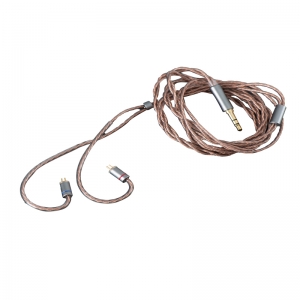
The shielding structure is also crucial in preventing signal loss.External electromagnetic interference can affect audio signals,especially in complex electronic environments.By adding shielding layers or using woven structures,the possibility of interference entering the conductor can be reduced,thereby minimizing signal distortion.For portable device usage scenarios,a good shielding design helps improve stability.
Interface quality directly affects the signal transmission effect.Poor contact between the plug and socket will increase contact resistance,resulting in signal attenuation.When choosing an upgrade cable for headphones,attention should be paid to the plating and processing accuracy of the interface.Stable contact can reduce signal loss and improve overall transmission efficiency.
The length of the cable also affects the degree of signal loss.As the length increases,resistance and parasitic parameters will increase accordingly,thereby affecting the quality of signal transmission.In actual use,an appropriate length should be selected according to the requirements to avoid unnecessary loss.
The usage environment also has an impact on the performance of the headphone upgrade cable.High humidity or temperature changes may affect the performance of the conductor and insulating materials,thereby affecting signal transmission.In daily use,excessive bending or pulling should be avoided to maintain the stability of the cable structure.
System matching is an important aspect for avoiding signal loss.The output capability of the audio source,the impedance of the headphones,and the characteristics of the cable need to form a reasonable match.If the overall system design is unreasonable,even if the cable performance is good,it is difficult to fully achieve the effect.Therefore,when optimizing the headphone upgrade cable,it is necessary to consider from the overall system perspective.
In summary,how to avoid signal loss in headphone upgrade cables is crucial in terms of conductor selection,structural design,shielding measures,and interface quality.By reasonably configuring these factors,signal attenuation can be reduced to some extent,maintaining the stability of audio transmission.

Dongguan Single Crystal Electronic Technology Co., Ltd.
Telephone:13560822605 Email:JC97608@126.COM
Company Website:www.occdj.com



 Wangwang