
Dongguan Single Crystal Electronics Technology Co., Ltd.
telephone:13560822605
fax:0769—22012936
mobile phone:13560822605
website address:www.occdj.com
Contact Person:赖先生
Many people purchase the Bixing Yin audio upgrade cables, and the problem they face is that they don't understand the specifications and models, fearing that they might buy the wrong one and be unable to use it. Especially for beginners, when faced with a bunch of parameters, they are completely at a loss. In fact, there's no need to remember complex terms. The core lies in looking at 3 points, and remembering these 3 points will enable you to easily make the right choice and avoid falling into traps, fully meeting the needs of daily purchases.
The first point is the interface specification. This is a crucial aspect. It needs to be completely matched with your headphones and the front end (player, mobile phone). Otherwise, if you buy it but it doesn't fit, it's a waste of money. Common interfaces mainly include three types. Just compare your equipment and choose accordingly: 3.5mm single-ended is universal and suitable for ordinary mobile phones and entry-level players, which is sufficient for daily use; 2.5mm balanced and 4.4mm balanced are commonly used by audiophiles. The sound transmission is more stable, and they can better leverage the advantages of the Bixing Yin cables; there is also a rare 3.5mm balanced interface. Before purchasing, be sure to carefully confirm the interface type of the headphones and the front end to avoid making a mistake due to carelessness.
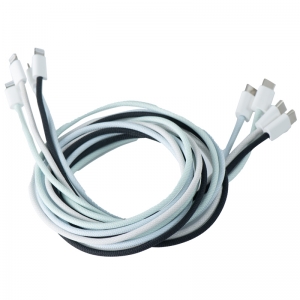
Secondly, the wire diameter and the number of strands. These two parameters will affect the conductivity and durability of the wire. There is no need to pursue the highest possible values; it's enough to meet your own needs. Common wire diameters include 0.78mm and 1.0mm, and the number of strands is mostly 16 strands, 24 strands, or 32 strands. Generally speaking, the more strands, the thicker the wire, and the better the conductivity and durability. The corresponding price will be slightly higher. If you only use it for daily listening and commuting, 24 strands will be sufficient to meet your needs; if you are an audiophile player and want to achieve a more delicate sound and better conductivity, you can choose 32 strands.
Thirdly, the plug and the pin. These small details are easily overlooked, but they affect the usage experience and durability. The plugs are divided into straight and L-shaped types. The L-shaped plug is more suitable for daily use scenarios, is less likely to break, and won't be damaged by bumps when placed in your bag; the pins need to be strictly matched with the headphone interface. Among them, MMCX and 2-pin are currently the most common types. When buying, be sure to check the pin model of your headphones and avoid buying the wrong ones if unsure. You can take a photo for comparison to avoid making a mistake.
Two additional tips to help you avoid pitfalls further: First, there is no good or bad in the specification and model; the key is to match your equipment. For example, for entry-level headphones, you don't need to choose a wire with a higher number of strands, as it wastes money and doesn't show its advantages. Second, when buying, you can double-check the interface and pin model to ensure accuracy before placing an order to avoid the hassle of returns and exchanges later.
Overall, the specification and model of the single crystal silver headphone upgrade cable doesn't need to be overly complicated. Focus on the three core points: interface, wire diameter and number of strands, and plug and pin. Combine your headphones and usage needs, and you can easily choose the right one. Even beginners won't fall into traps.

Dongguan Single Crystal Electronic Technology Co., Ltd.
Telephone:13560822605 Email:JC97608@126.COM
Company Website:www.occdj.com



 Wangwang